


Vintage Petrol Pumps
Vintage petrol pumps continue to captivate enthusiasts, and for Andy and Tim, they are a true passion.
With years of dedicated collecting behind them, this rust seeking-duo has uncovered hundreds of fascinating petroliana relics.
Their love for these nostalgic pieces not only showcases history also fuels their ongoing adventure in the world of vintage finds.
Join them as explore and celebrate the charm of these timeless treasures.


The Rise of the Petrol Pump:
Function, Design, and the Iconic Branded Globe
When the automobile first began rolling onto roads in the early 20th century, drivers faced a simple but pressing problem: where—and how—do you refuel? Early motorists often bought petrol in cans from general stores or pharmacies, a method that was slow, messy, and imprecise. As car ownership grew, so did the need for a dedicated, reliable way to deliver fuel.
This demand gave birth to the petrol pump—an invention that transformed refueling from a chore into a streamlined part of modern travel.
Early pumps appeared around the 1910s, evolving from basic hand-cranked dispensers (pictured left) into more sophisticated machines capable of measuring fuel accurately and safely. They quickly became a symbol of technological progress and convenience.
But petrol pumps didn’t stay purely functional for long. Fuel companies soon realised the power of branding, and the pump became one of their most valuable advertising stages. That’s when the illuminated glass globes appeared—those glowing, sculpted crowns perched atop pumps.
These globes served several important roles:
Visibility: In an age before neon signs and standardized forecourts, a glowing globe helped drivers spot fuel stations from a distance, especially at night.
Brand Identity: Companies like Shell, Texaco, and Mobil discovered that a distinctive globe acted as a beacon of trust and familiarity on the open road.
Design Appeal: Many globes were beautifully crafted—colored glass, strong typography, and sculptural shapes—all of which elevated a simple filling station into a visually memorable landmark.
By the 1920s and 1930s, the petrol pump had become an icon of roadside design—part utility, part marketing, part Americana (or its international equivalents). The combination of engineering, branding, and craftsmanship turned these fuel dispensers into pieces of industrial art.
Today, vintage petrol pumps and their glass globes are cherished collectibles, reminders of a time when even everyday infrastructure was designed with character, clarity, and style.
At Fergus & Gibbs we buy and sell unrestored petrol pumps. This enables us to retain the charm of rust and patina.
Here are some we have unearthed.

Gilbarco 🇺🇸
Gilbarco Veeder‑Root, commonly known simply as Gilbarco, is a leading U.S. name in fuel dispensing technology and petrol pumps. Its origins date back to the late 19th century, when the Gilbert & Barker Manufacturing Company was founded (circa 1865–1870). In the early 1900s, the company developed one of the first practical petrol measuring pumps for automobiles, playing a key role in standardising how fuel was accurately sold and dispensed at service stations.
← This was the first pump that Fergus and Gibbs found and purchased. It was nestling near a farm building near Holt, Norfolk.




Avery Hardoll AH101 🇬🇧
Avery‑Hardoll was a British engineering company that emerged in the 1930s, combining expertise from several manufacturers, including the well-known W. & T. Avery of Birmingham. By the late 1930s, they were producing petrol pumps and fuel-dispensing equipment for garages, service stations, and rural forecourts across the UK.
At 169.5 cm (5ft 6 3/4" ) tall the Avery Hardoll AH101 was introduced in the 1950s.
This model was superseded by the Model 'S' which was approx 6 inches smaller.
Avery Hardoll 3000 🇬🇧
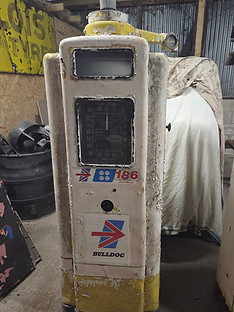
Avery Hardoll 3000 series, circa 1960-70s, vintage petrol pump in BP livery.
Note the evolving style change which excluded the glass globe which had been a prominent feature in past years.
Wayne Numerator 505 🇺🇸
Wayne was a prominent American maker of petrol pumps and fuel-dispensing equipment, widely recognised throughout the 20th century for its forecourt hardware. Established in the early 1900s as the Wayne Oil Tank & Pump Company in Richmond, Indiana, the company quickly gained a reputation for producing sturdy, dependable pumps that became a common sight at service stations across the U.S. and the UK.
Before digital systems, the 505 (1950s) used mechanical registers to track gallons and price with precision.
Its “numerator” counting mechanism was advanced for the time, reliable, and easy to read.
Wayne M70 🇺🇸
The Wayne M70 petrol pump is a classic mid-20th-century fuel dispenser, originally produced by Wayne Fueling Systems and widely used across forecourts in the 1940s and 1950s. Known for its durable steel construction, analogue display, and distinctive globe top, the M70 represents a key stage in the evolution of petrol pump design. Today, it is valued as a recognisable vintage piece, often restored or reproduced for use in automotive spaces, retail environments, and themed interiors.
Beckmeter M50 🇬🇧
Beckmeter was a British company renowned for manufacturing petrol pump meters, particularly during the mid-20th century. The firm focused on mechanical measuring devices for fuel dispensers, providing service stations across the UK with pumps that were valued for their accuracy, dependability, and easy-to-read mechanical displays. From the 1930s through the 1960s, Beckmeter pumps became a familiar sight at forecourts nationwide.
The Beckmeter M50 is special because it is a true working artefact of analogue fuel measurement.
Tokheim 952 🇺🇸
Tokheim is a historic American company founded in 1901 by John J. Tokheim, who invented and patented the world’s first visible gasoline measuring pump — a major innovation in how petrol was dispensed and sold to motorists. Early Tokheim pumps featured a glass cylinder that allowed customers and attendants to see fuel measured before delivery, helping build trust and accuracy in sales


Hunting Vintage Petrol Pumps
Join Andy and Tim on 'Hunting Vintage Petrol Pumps' and travel across the UK in search of rusty relics.
Not only will you see some fantistic old pumps, but you'll meet some collectors and pump enthusiasts.
Filming in 2025 is planned to start in November, so keep an eye out for new episodes.